Picture
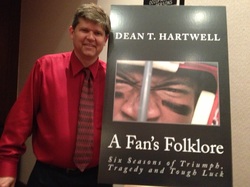
I am an avid sports fan and wrote the book A Fan’s Folklore: Six Seasons of Triumph,
Tragedy and Tough Luck
to revive baseball and football in the 1970s. By writing about the athletes, coaches and  games, I learned some things about myself.

 I remember Lyman Bostock, an outfielder who signed a large contract with the
California in early 1978.Though he was an exceptional (.300) hitter, he batted a dismal .147 in April 1978.

He went to the owner of the Angels, Gene Autry (the singing cowboy) and
told Autry that he was giving his money back because HE HAD NOT EARNED
IT.
 
Bostock’s integrity was exceptional. His shocking murder a few months later was tragic.They simply don’t make athletes like him anymore.
 
Writing  books allows me to reach people I would not otherwise reach. My writing about the “Immaculate Reception” is a case in point. On this controversial football play, it is a mystery who actually touched the ball, a question the referees had to guess in order to rule on the ending of a playoff game.
 
Using social media, I got the attention of one of the players involved in the play,
John “Frenchy”Fuqua. He emailed me back and told me he was going to show people like me that the play, which benefit his team the Pittsburgh Steelers, was “miraculous.”
 

A Fan’s Folklore
informs the reader as to some of the most remarkable players and games in baseball and football history.It asks the reader to place themselves in the position of those who played the game and ask what they might have done.
 
Consider the so-called “Holy Roller” in which Oakland Raider quarterback Ken Stabler was about to be tackled by an opposing player as time ran out on the game.As the other player was about to grab his throwing arm and toss him to the ground, he had a split-second to decide whether to “cheat” by rolling the ball forward in the hopes a teammate could make a play or to quit by falling on the ball.

How does that sound – Be a cheater or be a quitter?

From this context, the players teach us about ethics in a way that nothing else
could. So grab this book and learn a little about yourself!
---
Book available here
 
 
Picture
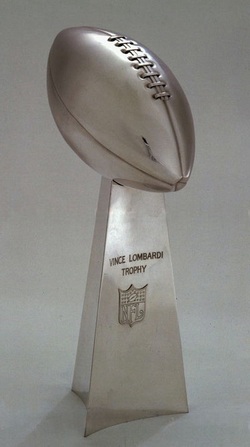
Lombardi Trophy for the Winner!
The Super Bowl pits the champions of two conferences, the American Football Conference (AFC) and the National Football Conference (NFC) in one winner-take-all game.  Much has been written about the players who have competed and the plays they have made which helped make some teams winners and others losers.

I have enjoyed reading about the play of the teams, but my focus is on something even more important.  I analyze the strategy used by the teams in games where it made the difference in the outcome of the contest.  By strategy, I mean decisions that coaches and players had time to dwell upon before selecting a specific option.

Strategies include, but are not limited to:

Going for one or two point conversions

Using a specific type of defensive or offensive or special teams play

Directing players to get out of bounds to save time or to avoid getting out of bounds to use up the clock (also known as time management)

Attempting a field goal or going for the first down or touchdown

Here is one of my “cases,” Super Bowl X:

Roger Staubach’s interception on the final play of Super Bowl X was not a strategy. Staubach, his coach Tom Landry and his teammates had little, if any, time to decide what play to choose.  And there wasn’t much of a choice, anyway. The team had to move the ball thirty-nine yards in three seconds.  The “Hail Mary” pass, which had worked so well weeks earlier in the playoffs against the Minnesota Vikings, failed here not because the Cowboys chose to throw deep, but because the Steelers knew it was coming and effectively handled the play as would be expected.

On the other hand, Staubach’s decision about time management upon getting the ball back from the Steelers late in the game and down by 4 points WAS a strategy. The Cowboys had time to decide how to manage the clock (1 minute, 22 seconds), the yardage (61 yards) and time outs (none) to get the necessary points to win the game. On first-and-ten, Staubach could not find a receiver and ran with the ball. He had a chance to go to the sidelines to stop the clock but instead ran further upfield. He got ten yards on the play but gave up precious time and probably the game in the process.

Here is a chart of the game's final plays, all offensive plays by the Cowboys.  Note the field at the far right hand side, the Yards Needed/Second (YND/SEC).  As the series of plays starts, this number is a little more than .74.  In short, the Cowboys needed to make an average of three yards per four seconds to win the game.


Of course, the circumstances which led to the final series of plays and the strategy on how to attempt to score were set in place earlier.  If we look at this game backward, we can best determine earlier strategies that might have averted the situation the Cowboys found themselves in.

Below I have re-printed the last four series, two by each team.  This will enable us to look backward to the point where Dallas strategy cost them the game.

PITTSBURGH: 4:25

  1-10 P30  F.Harris 4 rush up middle (J.Pugh).

    2-6  P34  F.Harris 2 rush off right tackle (E.Jones, C.Harris).

    3-4  P36  T.Bradshaw 64 pass to L.Swann deep middle (catch at D5), touchdown (11:58).

    R.Gerela's extra point attempt hit the left upright, no good.

    PITTSBURGH 21, DALLAS 10

R.Gerela kicked into end zone, touchback.

DALLAS: 3:02

  1-10 D20  R.Staubach 7 pass to C.Young middle (A.Russell).

    2-3  D27  R.Staubach 30 pass to D.Pearson deep right (J.T.Thomas).

    1-10 P43  R.Staubach 11 pass to P.Pearson left (A.Russell).

    1-10 P32  R.Staubach sacked, loss of 2 (D.White).

               TIMEOUT:  Two-Minute Warning.

    2-12 P34  R.Staubach 34 pass to P.Howard left end zone, touchdown (13:12).

               T.Fritsch kicked extra point.

     PITTSBURGH 21, DALLAS 17

T.Fritsch onside kicked to D42, recovered by G.Mullins, no return.

PITTSBURGH: 1:48

  1-10 D42  F.Harris rush left, loss of 2.

               TIMEOUT:  Dallas (1st).

    2-12 D44  F.Harris 2 rush left.

               TIMEOUT:  Dallas (1:33-2nd).

    3-10 D42  R.Bleier 1 rush left.

               TIMEOUT:  Dallas (1:28-3rd).

    4-9  D41  R.Bleier 2 rush right tackle (E.Jones).

 
DALLAS: 1:22

  1-10 D39  R.Staubach 11 keeper left.

    1-10 50   R.Staubach 12 pass to P.Pearson (M.Kellum).

    1-10 P38  R.Staubach recovered own fumble, pass to D.Pearson overthrown.

    2-10 P38  R.Staubach pass to P.Howard right end zone broken up (J.Lambert).

    3-10 P38  R.Staubach pass to D.Pearson deep intercepted two yards into end zone, G.Edwards 35 return to P33.

GAME OVER - PITTSBURGH 21, DALLAS 17

Right before Dallas took over on its own 39 yard line with 1:22 remaining in the game, Pittsburgh had run the ball on a 4th down and 9 from the Dallas 41 yard line.  To this day, some question the call that Steeler head coach Chuck Noll made because it almost ensured that Dallas would get the ball in good field position.  In fact, Rocky Bleier took a handoff for two yards, well short of the first down.

Why didn’t Noll order a punt?  A smart coach who would end up winning what is still a record four Super Bowls, he undoubtedly considered the option of punting.  But earlier in the game, his punter Bob Walden dropped a snap from center, which led to a Dallas touchdown and 7-0 lead.  If Walden again dropped the ball, or the Cowboys blocked the punt or made a good return, Dallas would have an excellent opportunity to win the game.

Instead Bleier held on to the ball and the Steelers gave the ball to the Cowboys on the Cowboy 39 yard line.  Noll estimated correctly that Staubach and Company could not make the winning score.

A better question has to do with strategy before the Steeler set of downs.  With 1:48 to go in the game, Staubach threw deep to Percy Howard in the Steeler end zone for a touchdown.  The extra point made the game Steelers 21, Cowboys 17.

Dallas had all three of its time outs left.  So, provided that they could hold the Steelers without a first down, they could use the time outs and get the ball back with plenty of time to go.  And, given that Steeler starting quarterback Terry Bradshaw had left the game (for good) due to an injury moments earlier, the Steelers chances of making a first down seemed fairly slim.  In fact, backup quarterback Terry Hanratty, sent into the game as a replacement, had not thrown a single pass all season!

The Cowboys should have known that Hanratty would turn around and hand the ball off to either Franco Harris or Bleier.  They could have counted on getting the ball back.

The real strategy decision, then, should have been one that ensured good field position.  Instead of an onside kick, which works at best about one time in four when the other team (as in this case) expects it, Dallas should have kicked off deep.  A touchback, followed by three carries for one yard, would have put the Steelers on their own 21 with a 4th and 9.

Then the Steelers would have to punt.  This is the essence of strategy: make the other side do something they do not wish to do!

Walden punted four times on the day.  The first three punts went for 32, 34 and 34 yards and each time the Cowboys took a fair catch.  Walden boomed the fourth punt for 59 yards after which Cowboy Golden Richards returned it five yards.

Now the odds are three in four in FAVOR of the Cowboys and even better if there were a problem with the snap or a blocked kick.  A 34 yard Walden punt with a fair catch would put the ball on the Dallas 45, which happens to be the same place Dallas would get the ball with a successful onside kick!

In short, the only difference between what the Cowboys could have gotten as a best-case scenario with the poor strategy and what they likely would have accomplished with better strategy was twenty-six seconds, time that they would not need, anyway.

Chalk this Steeler win up to Chuck Noll!

Here is the actual Play-by-play of Super Bowl X (January 18, 1976)


Picture
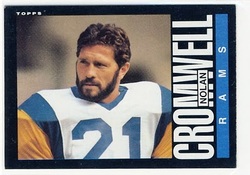
Rams safety Nolan Cromwell
I recounted Super Bowl XIV in my last article.  In the end, the better team beat the underdog.  The final score gave the Steelers a healthy 12 point advantage, but the score masked the closeness of the game.

While the Steelers had the sheer talent to come back to defeat the Rams, there was more to it than that.  Plays that were a matter of inches, a player’s misfortune or other unforeseeable events turned on a dime and the game with it.

My purpose is to take one of these game-breaking plays and turn it in another direction and then estimate the result of the game from that point.

The play I chose took place with about nine minutes to go in the third quarter.  The Steelers had the ball 1st and 10 from their own 44 yard line.  In reality, Bradshaw passed the ball into the arms of Rams defensive back Nolan Cromwell, who, with only the Steeler end zone in front of him, dropped the ball!

Cromwell was an exceptional athlete who could have played quarterback or running back.  I want this play back because his teammates have said he would have caught the ball 99 times out of 100.  So here goes my projection of the rest of the game, using the real plays and results that followed to the extent practical.

---

Corral’s extra point after Cromwell’s touchdown makes the score 26-17 in favor of the Rams.  On the kickoff, Larry Anderson takes the ball to the Pittsburgh 37 with 9:06 to go in the third quarter.

After two short runs by Harris, Bradshaw throws to Harris for a first down at the Ram 39.  On the next set of downs, Bradshaw, again facing third and five, can’t find a receiver and scrambles for a first down.

A pass to Thornton gets the Steelers inside the Ram 10, but Bradshaw suffers his third interception when Elmendorf deflects a pass intended for Stallworth and Perry catches it in the end zone for a touchback.

Ferragamo and the Rams take over at their own 20 with 3:30 left in the third quarter.  A couple of Tyler runs take them to the Ram 33, but a subsequent sack of Ferragamo costs them a chance at another first down.  Clark’s long punt is returned by Smith to the Steeler 25 as the third quarter ends.

Harris runs left for two yards before Thornton drops a pass from Bradshaw.  On third-and-eight, Bradshaw rolls the dice and hits John Stallworth in stride at the Ram 32.  No one can stop the wide receiver from scoring on a 73-yard play.  Bahr’s extra point makes the score Rams 26, Steelers 24.

The two teams exchange punts.  The Rams get the ball back on their own 16 yard line.  Two straight completions to Dennard put the ball on the Ram 48.  Tyler runs for a first down and then slips on the next play.  Ferragamo tries to connect with Nelson but the pass is overthrown.

This brings up 3rd down and 13 from the Steeler 47.  Ferragamo finds Waddy on the right sideline for fifteen yards to get a first down at the 32.

Ferrago hands off twice to Wendell Tyler.  The second rush gets the Rams to the 25.  On third-and-three, Ferragamo tries Bryant, who is stopped a yard short of the first down.

After the 2 minute warning, Malavasi sends in the field goal unit.  Corral runs up to the ball, but Cromwell pulls it away and makes a run for the right side.  But the Steelers, who were familiar with Cromwell’s successful play against the Cowboys, stopped him short of the first down.

Steeler ball on their own 23 with 1:50 to go in the game.  Both teams have all three time outs available.

Bradshaw starts by passing to Harris, who makes a gain of 14.  Using a “hurry-up” offense, Bradshaw calls for a pass to Stallworth, but Cromwell breaks it up.  After the Steelers are called for a false start, Bradshaw throws to Smith for a short gain before Smith gets out of bounds.

It is now 3rd and 9 from the Steeler 38 with 1:18 to go.  Bradshaw decides to throw it deep to Smith, but Brown makes a spectacular catch in front of him for an interception.

After Ferragamo kneels on the ball twice, the game is over with the Rams 26-24 winners.  Ferragamo takes the Most Valuable Player Award.


See the actual Super Bowl XIV play-by-play here


This essay appears in Dean T. Hartwell's A Fan's Folklore: Six Seasons of Triumph, Tragedy and Tough Luck available at Amazon.com and other retailers.
 
 
To read about "Pittsburgh Justice," go to the "Excerpts" page here
 
 
This excerpt appears in Dean Hartwell's A Fan's Folklore: Six Seasons of Triumph, Tragedy and Tough Luck, available on Amazon


You will find this chapter in Dean T. Hartwell's JUST-RELEASED book A Fan's Folklore: Six Seasons of Triumph, Tragedy and Tough Luck out later in 2012.  Click here!
 
 
I will host D'Anne Burley's "The Detectors" podcast on Friday, September 9th with my guest Bob Fox of the Wisconsin Sports Online.  We will discuss the upcoming football season and the Packers' chances to repeat as Super Bowl champions, Fantasy Football and union and racial issues.  Tune in on this link 4:00 pm Pacific time!