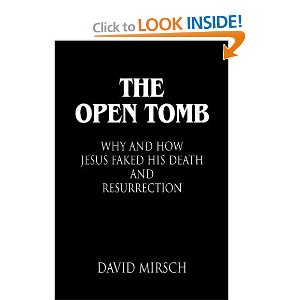
Here are a series of questions I raised in an earlier essay about this subject. My original answers are first, followed by new answers provided by a book I recently read and reviewed called Open Tomb: Why and How Jesus Faked His Death and Resurrection by David Mirsch:
When Was Jesus Born?
No one has been able to ascertain exactly when Jesus was born. Scholars typically place the year of his birth at around 4 BC (Before Christ) or BCE (Before Common Era).
Open Tomb posits that Jesus was born in 6 BCE.
When did Jesus die?
As with his birth, there is no certain year for his death. Scholars put his death at around 30 CE (Common Era).
Open Tomb points to John 8:57, a verse that implies that Jesus was more than forty years old, and uses the old Jewish calendar and the Biblical indications of when Passover and other events took place to put the crucifixion at 37 CE.
What did Jesus tell people about the coming Kingdom of God?
He told them that it would take place during their lifetimes. (Matthew 23:26 and 24:34)
Open Tomb discusses Jesus’ statements as said in code. Jesus covered his real agenda, revolution, in comments that made reference to people and places. The Kingdom of God was the rule of God, expressed through the Old Testament, coming back to the region of Israel with a king directly from the line of David in charge.
When did the Apostle Paul, one of the earliest Christian writers, begin to preach?
Paul makes no mention in his letters of the destruction of Jerusalem, which took place in 70 CE. It is reasonable to assume he must have written them before that point in time. Paul was an early persecutor of Christians and subsequently had his “conversion” to Christianity some time later. So, it is widely thought that he wrote his letters somewhere around 50-60 CE.
Open Tomb discusses the Apostle Paul as only vaguely mentioning Jesus, almost as though he was another person.
What is significant about Paul’s letters?
Paul states in 1 Corinthians 15:6 that there were 500 witnesses to the risen Jesus but gives no names even though he says they are still around.
Open Tomb’s ideas are expressed above.
When were the Gospels put into writing?
Paul never says anything about what we now call the Gospels (of Matthew, Mark, Luke and John), so his preaching must have taken place before they were put into writing. Scholar consensus has the Gospels starting around 70 CE with Mark, Matthew and Luke and ending with John in about 90 CE.
Open Tomb places the Gospel starting time as shortly after the crucifixion in 37 CE.
What do you think?
When Was Jesus Born?
No one has been able to ascertain exactly when Jesus was born. Scholars typically place the year of his birth at around 4 BC (Before Christ) or BCE (Before Common Era).
Open Tomb posits that Jesus was born in 6 BCE.
When did Jesus die?
As with his birth, there is no certain year for his death. Scholars put his death at around 30 CE (Common Era).
Open Tomb points to John 8:57, a verse that implies that Jesus was more than forty years old, and uses the old Jewish calendar and the Biblical indications of when Passover and other events took place to put the crucifixion at 37 CE.
What did Jesus tell people about the coming Kingdom of God?
He told them that it would take place during their lifetimes. (Matthew 23:26 and 24:34)
Open Tomb discusses Jesus’ statements as said in code. Jesus covered his real agenda, revolution, in comments that made reference to people and places. The Kingdom of God was the rule of God, expressed through the Old Testament, coming back to the region of Israel with a king directly from the line of David in charge.
When did the Apostle Paul, one of the earliest Christian writers, begin to preach?
Paul makes no mention in his letters of the destruction of Jerusalem, which took place in 70 CE. It is reasonable to assume he must have written them before that point in time. Paul was an early persecutor of Christians and subsequently had his “conversion” to Christianity some time later. So, it is widely thought that he wrote his letters somewhere around 50-60 CE.
Open Tomb discusses the Apostle Paul as only vaguely mentioning Jesus, almost as though he was another person.
What is significant about Paul’s letters?
Paul states in 1 Corinthians 15:6 that there were 500 witnesses to the risen Jesus but gives no names even though he says they are still around.
Open Tomb’s ideas are expressed above.
When were the Gospels put into writing?
Paul never says anything about what we now call the Gospels (of Matthew, Mark, Luke and John), so his preaching must have taken place before they were put into writing. Scholar consensus has the Gospels starting around 70 CE with Mark, Matthew and Luke and ending with John in about 90 CE.
Open Tomb places the Gospel starting time as shortly after the crucifixion in 37 CE.
What do you think?

 RSS Feed